There is a particular kind of showroom that surprises you. You pull into the parking lot in West Haven, past the unremarkable strip of commercial buildings, and you think: this can’t be it. It doesn’t look like the kind of place that could change your house.
Then you walk through the door.
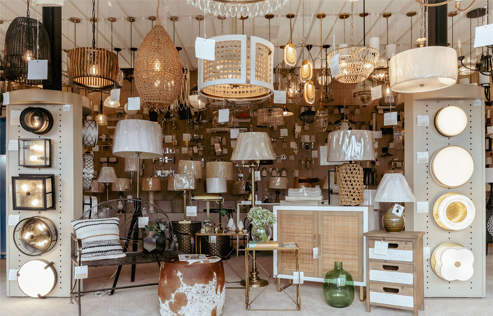
Your Lighting Source is a high-ceilinged space that hums with possibility. Every inch of wall is hung, every table layered, every corner stacked with fixtures that range from quietly sensible to genuinely showstopping — and what strikes you immediately is not the volume of it, but the range. Nothing here feels like a compromise or a placeholder. From an accessible price point to full luxury, it is all well-made, all considered, and presided over by a woman who has forgotten more about lighting than most people will ever know. She was a lighting designer before she ran this store. She goes to the shows. She knows what is trending and what is timeless and, crucially, the difference between the two.
Most of our clients, before they work with us, have stood in the lighting aisle at a big-box store and assumed that is simply what is available. They walk the fluorescent rows, pick something inoffensive, and move on. What they do not realize is that the right lighting source — pun intended — is one of the best-kept secrets in Connecticut residential interior design. Your electrician will thank you. Your house will thank you. And years from now, when your fixtures still look deliberate and alive, you will thank yourself.
On a recent afternoon, I brought a client here to do exactly that: make her lighting deliberate, and make it alive.
The Client and the House
She is the kind of woman whose accessories do the talking before she says a word. Slicked-back hair with a clean center part, gathered into a simple bun. Layers of thin gold bangles, a stack of delicate necklaces, clothes that are quietly on-trend without being loud about it. She has an eye. She has always had an eye. The kind of person for whom “curated” is not an aspiration but a default setting.
Her project was, by any measure, an extraordinary one: a complete rebuild on her family’s property on the marsh shoreline in Branford, Connecticut. Her father is an architect, and he designed the home with real intention — a generous, graceful house for a family of five, with a basement suite for her in-laws. Throughout every room, he carried a signature detail he returns to in every home he builds: lighting recessed directly into the window sills, so each space carries its own quiet, architectural glow. It is one of those ideas that sounds simple until you see it in person, and then you cannot imagine a room without it. That recurring element would become the thread running through our entire conversation at the showroom — the thing every fixture decision had to honor.
She had a sweeping vision for the house — bold enough to be interesting, restrained enough to never tip into overwhelming. She came to me having already weighed in on tile, pulled together couch and rug selections, and formed strong opinions about nearly every room. What she needed was not someone to design for her, but someone to walk alongside her: to validate the instincts that were already sound and to gently complicate the ones that were playing it too safe.
Lighting, she told me, was where she needed the most help. And so we made a plan.
The Risk of Playing It Safe
Here is what I see happen in new builds, again and again: homeowners make courageous decisions in some rooms and then retreat to safety in others. They choose a spectacular tile for the master bath and a perfectly inoffensive pendant for the kitchen. They go bold on the sofa and then reach for the most reliable fixture in the showroom the moment things feel uncertain.
It is understandable. Lighting is expensive, lighting is permanent, and lighting — unlike a throw pillow — involves electricians and drywall if you change your mind. The stakes feel higher, and so people hedge.
My client’s instinct, before we arrived at the showroom, had been toward Visual Comfort for everything — fixtures known for clean lines, reliable quality, and a look that will never embarrass you. And look: Visual Comfort is excellent. We used them in this very house, more than once. But “will never embarrass you” is not the same as “will stop you in your tracks,” and this client, with her stacked bangles and her architect father and the color-drenched den she had already committed to, was not a woman whose home should simply not embarrass her.
Her home should look like her.
The challenge of this consultation was not solving a problem — she had no disasters in progress, no irreversible mistakes to work around. The challenge was convincing a woman with already-excellent taste to trust that taste fully, in every room, even the ones where safe felt easier. She is enthusiastic and quick, not someone who needs to be dragged toward a decision. What she needed was permission.
The Afternoon at Your Lighting Source
She arrived prepared. I had sent her links and brand suggestions in advance — a curated shortlist to review before we met — and she had gone through them methodically, arriving with a spreadsheet that mapped each room to its lighting needs. I loved this. She knew her spaces, she knew her questions, and she knew, roughly, what she was drawn to. The work of the afternoon was not to start from zero but to move through the house room by room and ask: is every need covered, does every fixture earn its place, and does it all, taken together, tell a coherent story?
We started with the rooms that were already nearly resolved and saved the two that needed real conversation for last: the den and the primary bedroom. Those were the rooms where her instincts were good but not yet great, and where a small push would produce something genuinely memorable.
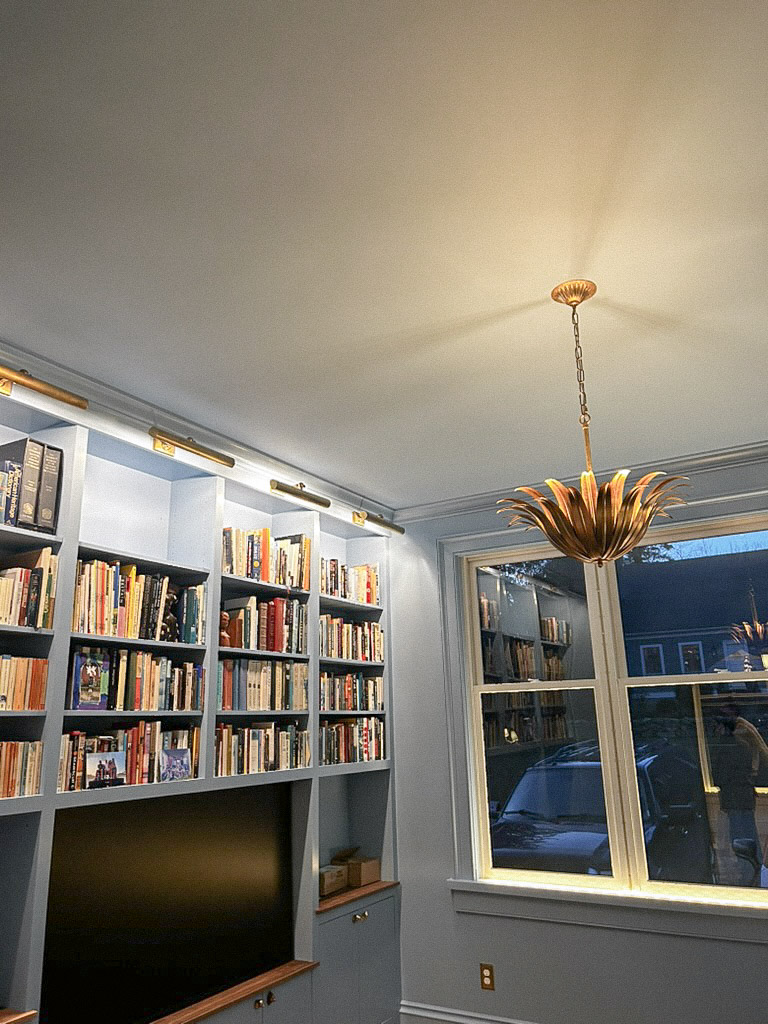
The den had already made a commitment before we arrived. She had color-drenched it — ceiling, trim, and a beautiful built-in bookcase — in a deep, saturated blue. It is a bold choice, and it is exactly right. A room like this does not need timid lighting. At the top of each column of the bookcase, we sourced Visual Comfort’s classic picture lighting — a decision that seems decorative until you see it functioning. Those fixtures do not just illuminate the books; they give the bookcase architecture. Each column becomes intentional. The room glows. For the center, we brought in a chandelier from Arhaus, something with genuine personality that meets the room’s energy rather than retreating from it. And because those deep blue walls called for warmth, we landed on bronze throughout the den — the one room in the house where we departed from the silver and gold she gravitates toward elsewhere.
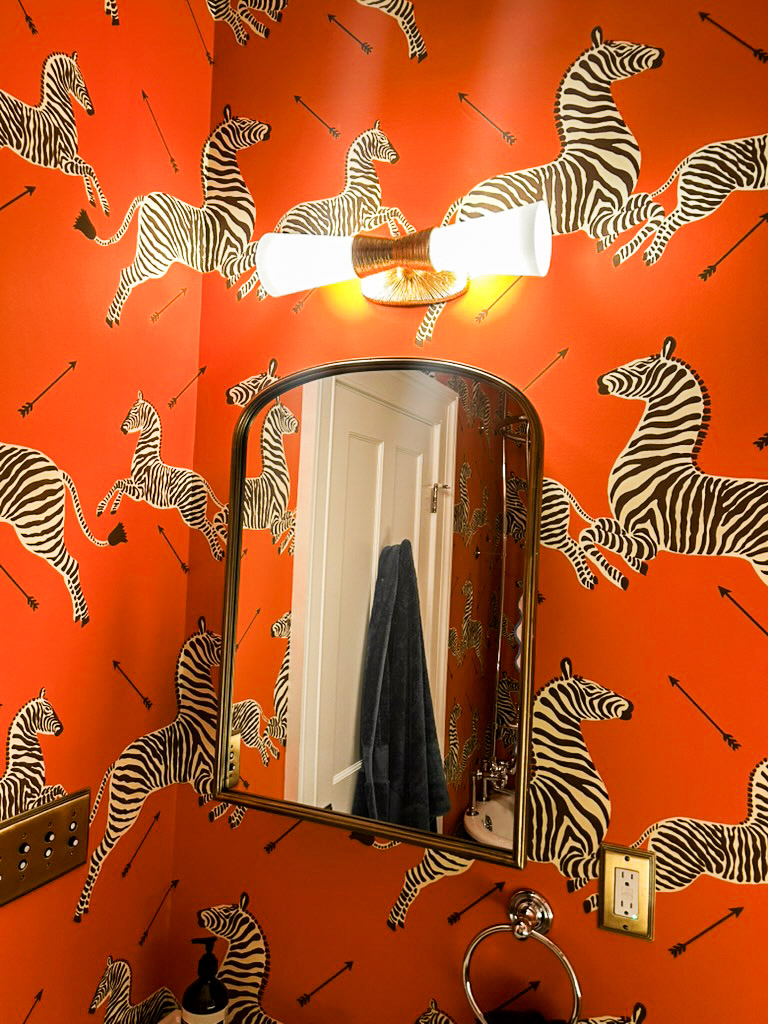
The guest bath required almost no persuasion. She had already committed to a bold orange zebra wallpaper that announced itself the moment you crossed the threshold. This is not a room for the timid, and it did not need a timid fixture. We sourced a Visual Comfort piece that played with the pattern and energy of the wallpaper rather than competing with it. When the right fixture meets the right room, you do not have to explain the decision. It simply looks inevitable.
Then we came to the primary bedroom, and that is where the real conversation happened.
She came in with a plan: two sconces, one on either side of the headboard, simple and classic. And the sconces we chose are genuinely beautiful — a hinged wall sconce in silver with a clean white shade, elegant and understated. I had no argument with the sconces.
My argument was that the sconces alone did not show who she was.
A primary bedroom is the most personal room in a house. It is where you wake up and where you end the day, and it should feel, above all, like yours. Two matching bedside sconces, however well-chosen, read as a decision made from a checklist. They do not stop you. They do not make you smile when you flip on the light for the first time.
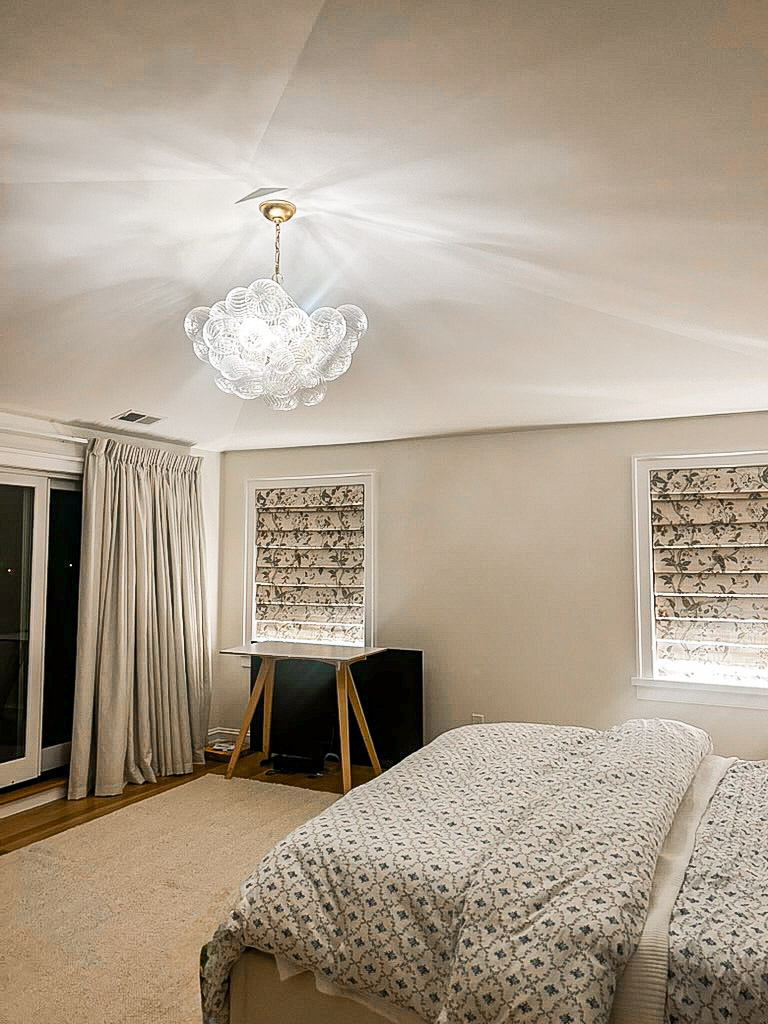
I proposed a bubble chandelier above the bed — a fixture that has had a remarkable moment in residential interior design for good reason. It brings sculptural presence to a room without weight. It is romantic without being fussy. And in a bedroom that would otherwise rely entirely on the sconces for character, it is the element that makes the whole room feel finished rather than simply furnished.
She hesitated for approximately thirty seconds. Then she loved it.
That is usually how it goes. The hesitation is about risk. The love is about recognition — of a room that finally looks like the person who lives in it.
Across the remaining spaces, her instincts were already heading in exactly the right direction. She loves classic silhouettes — little lampshades, clean lines, fixtures that read as considered without being costumey. Silver ran throughout as the dominant finish, consistent and warm, tying the house together the way good jewelry ties together an outfit. Her father’s window-sill lighting threaded through every room like a signature, a recurring element that made the house unmistakably his — and, because it is hers too, unmistakably theirs.
Nearly everything was ordered through Your Lighting Source, who handled shipping and receiving on our behalf. The Arhaus chandelier for the den was the single exception. Being able to hand that logistics chain to a trusted partner is one of the great, underappreciated advantages of working with a real lighting showroom — the kind of thing that makes a project run rather than lurch.
The Thing I Want Every New Build Client to Hear
You are going to be tempted, at some point in your build, to choose the safe fixture. The one that will definitely work. The one that will not raise any eyebrows or require any explanation. The one that, in twenty years, you will look at and feel nothing.
I understand the temptation. New builds are expensive and complicated and exhausting, and by the time you get to lighting, the decision fatigue is real. Safe feels like relief.
But here is what I have learned, after years of standing in showrooms with clients: the rooms people love the most are never the safe ones. They are the rooms where someone took a chance — on a color, a scale, a fixture that made them a little nervous. The nervousness, almost always, is the signal that the choice is exactly right.
Lighting is jewelry. It is the last layer, the one that makes everything else make sense. A great necklace does not have to match every piece in your wardrobe — it has to feel like you. Your fixtures should do the same. They should feel like you, and like the life you are building in that house, and not like the safest available option in a showroom you happened to visit.
You only build your forever home once. Choose the chandelier that stops you.
The End of the Afternoon
We wrapped up after a few hours, having worked through every room on her list. There was that particular kind of satisfaction that comes from a plan fully made — not just the individual decisions, but the sense that they all belong to each other, that the house, taken as a whole, tells a single story.
She left with more than a fixture list. She left with clarity about the kind of home she was building — one that is bold enough to be interesting, personal enough to be irreplaceable, and lit, finally, the way it deserves to be.
If you are in the middle of a new build — in Branford or Milford or anywhere along the Connecticut shoreline — and you are staring down a lighting plan that feels overwhelming or, worse, just fine: that is exactly what a consultation is for.
Sources & Shop the Look
Cabinet Maker’s Picture Light — Visual Comfort
Utopia Small Double Bath Sconce — Visual Comfort
Brass Cluster Ribbed Glass Globe Bubble Chandelier — Light Fixtures USA
Your Lighting Source — West Haven, CT
Reach out to Seawillow Studio. We will find the fixture that makes you a little nervous. And then we will help you choose it.
Seawillow Studio | Milford, CT | Full-Service Interior Design Connecticut Residential Interior Design — Coastal, Modern Traditional, Timeless

