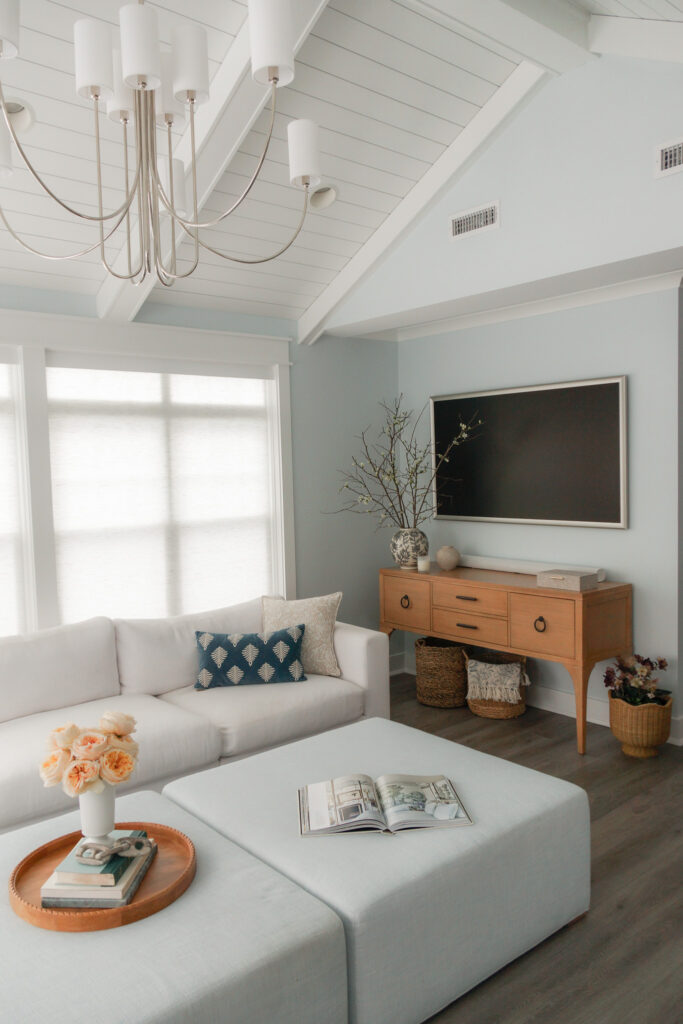
When a client moves into a newly renovated home that simply doesn’t feel like them, the challenge isn’t construction — it’s curation. This den refresh is a study in restraint, intention, and the kind of quiet luxury that makes a room feel personal without ever feeling overdone. For Seawillow Studio, a Connecticut-based interior design firm, it’s exactly the kind of project we love most: no demolition, no gut renovation, just a series of considered decisions that accumulate into something genuinely beautiful.
The Space & The Story
Perched along the Connecticut coastline, this sun-washed cottage belonged to a pair of empty nesters ready to downsize — but not ready to sacrifice style. They’d traded their larger family home for something smaller and more manageable, yet their vision was anything but modest: a flexible, elevated space that could feel intimate on a quiet Tuesday evening and expand gracefully for family gatherings, holiday celebrations, and the occasional full house of children and grandchildren.
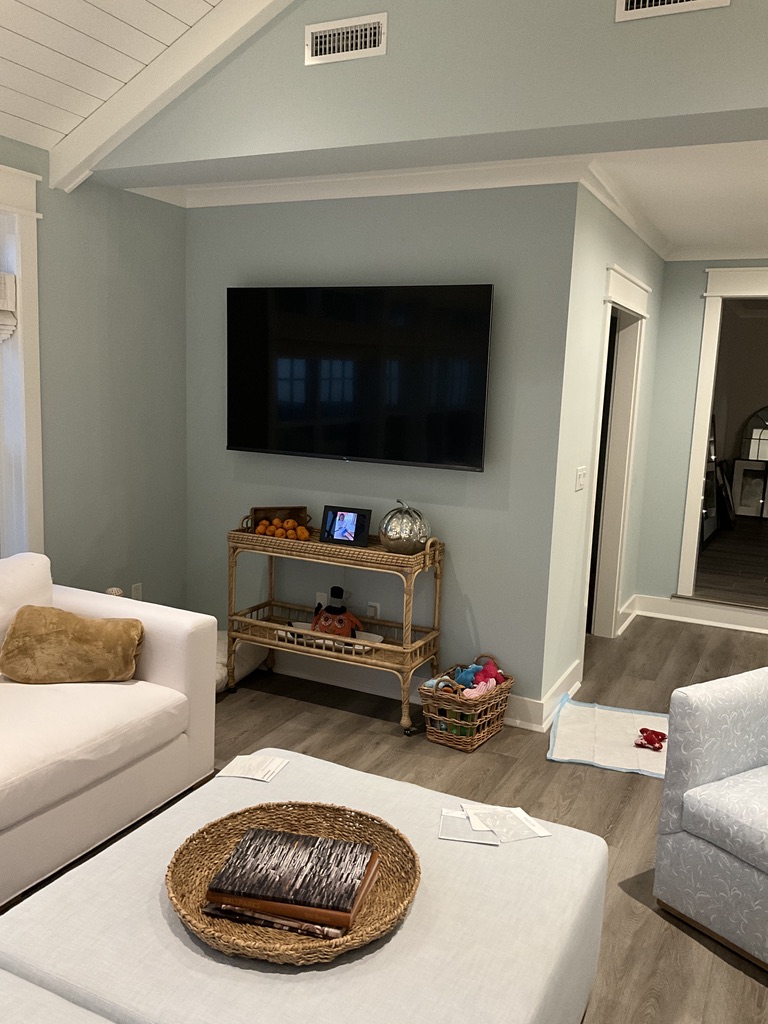
The home had been recently renovated before they arrived, which meant the bones were solid and the finishes were fresh. But “recently renovated” doesn’t always mean “designed with intention,” and this client knew immediately that the space didn’t reflect who she was. The renovation had been competent. It just hadn’t been her.
As a Connecticut interior designer, this is one of the most common calls we receive — clients who’ve inherited someone else’s taste and are ready to make a space their own without starting from scratch. The good news is that a thoughtful refresh, executed with a practiced eye, can be just as transformative as a full renovation. Often more so, because the energy goes entirely into design rather than construction.
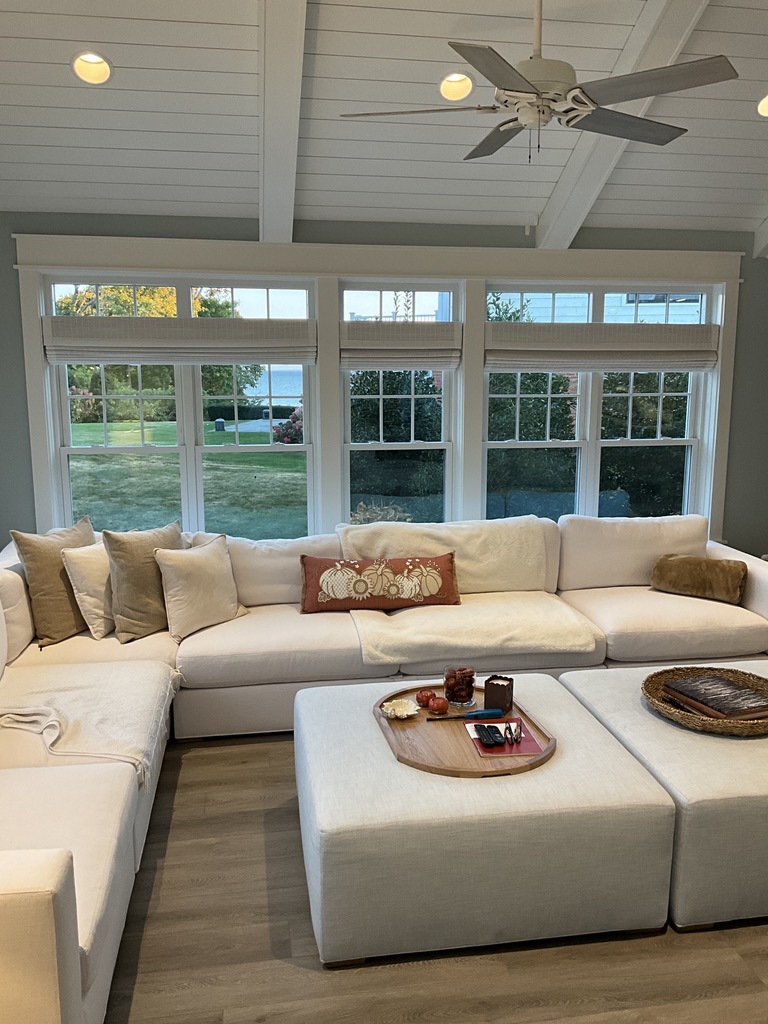
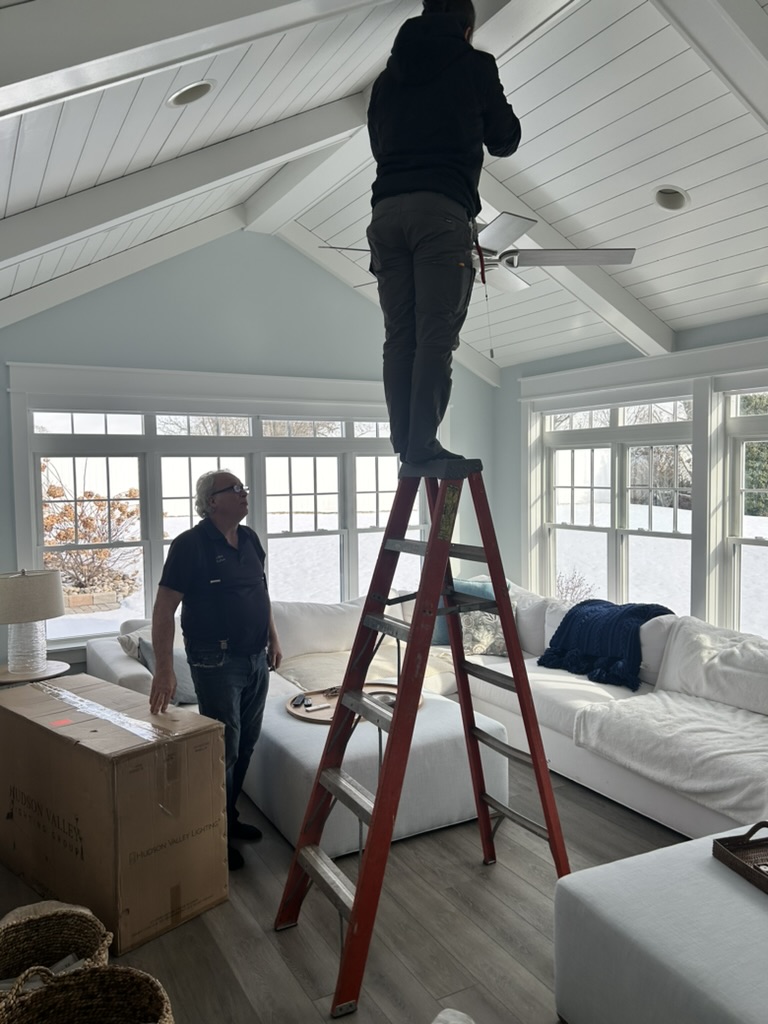
The existing inside-mount flat fold roman shades were brand new — and completely wrong. In a heavy linen weave, they leaned into a coastal theme that veered quickly toward dowdy. The shiplap ceiling with its builder-grade ceiling fan felt uninspired. And while the views beyond those windows were genuinely stunning — a sweeping, uninterrupted glimpse of the ocean — the blind format was actually cutting off that connection, adding visual weight to a room that desperately needed to breathe.
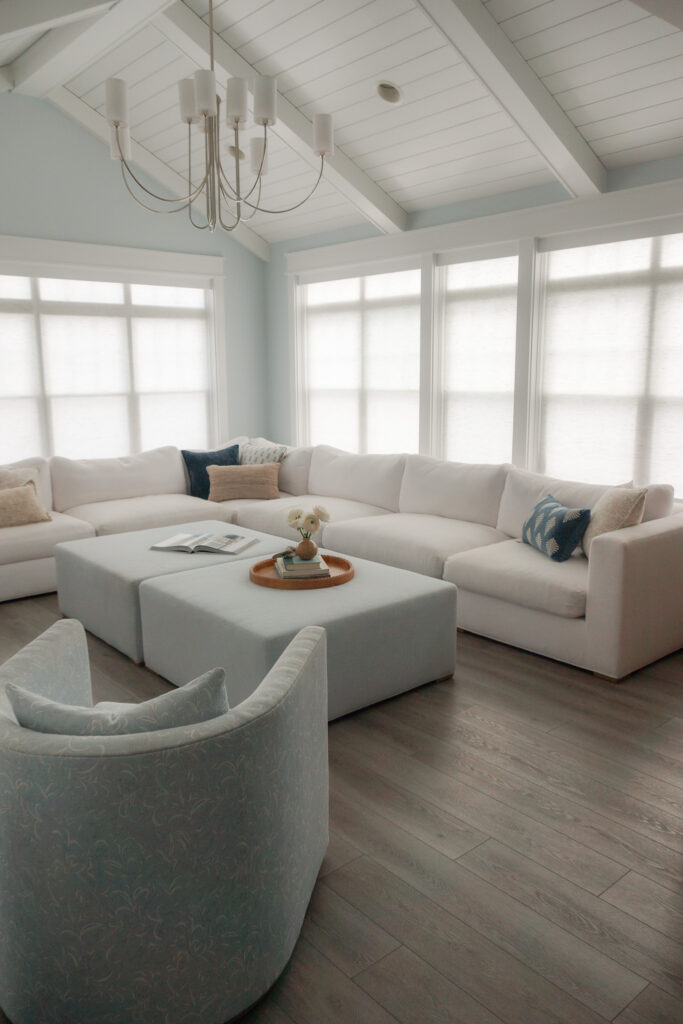
She had, in a moment of excellent instinct, already impulse-purchased a gorgeous L-shaped sofa and ottoman from Serena & Lily before we came on board. It was perfect for her lifestyle and exactly the kind of piece a room should be built around. It also filled the space considerably, which meant every subsequent decision needed to be made with care, intention, and a clear understanding of what the room could and couldn’t hold.
Client Vision: Coastal Quiet Luxury
This client had a clear aesthetic language, even if she didn’t quite have the vocabulary for it yet. She favored silvers and cool white-grays. She loved clean lines and low visual clutter, but was instinctively drawn to furniture with ornate, feminine detailing — a tension that, when handled well, produces some of the most interesting and layered interiors we encounter in our Connecticut design work.
Her brief, distilled: coastal, but elevated. Not beach-themed. Quiet luxury.
She wasn’t looking for a gut renovation or a complete overhaul. She wanted a visual upgrade — the kind that makes guests pause at the doorway and say, this room is beautiful — without necessarily being able to articulate why. That ineffable quality, where design recedes and atmosphere takes over, is something we think about constantly at Seawillow Studio.
The challenge for us was to honor her specific aesthetic while staying true to our signature approach: natural materials, considered layering, and spaces that feel collected over time rather than decorated in a single afternoon. Balancing her preference for cool silvers and white-grays against our instinct toward warmth and organic texture required careful calibration — but that balance, ultimately, is what gives the finished room its depth.
What she didn’t want was equally instructive. No anchors, no driftwood, no navy-and-white stripe. The ocean outside the window was reference enough. Inside, the coastal influence needed to be felt rather than stated — present in the light quality, the cool palette, the sense of airiness — without ever becoming a theme.
The Challenges: Sourcing, Supply Chains, and Spatial Complexity
No project arrives without complications, and this one had several worth discussing honestly — because we think transparency about process is part of what makes working with an interior designer valuable.
Supply chain disruptions, still reverberating from the pandemic when we began this project, affected nearly every sourcing decision we made. We waited close to a year for one table and nearly six months for another. Subsequent tariff changes added an additional layer of uncertainty to an already unpredictable sourcing landscape. For a client eager to see her space come together, patience became a genuine part of the process — and communicating clearly about timelines, offering interim solutions, and keeping the vision alive during long waits is something we take seriously.
It’s one of the less glamorous realities of interior design in Connecticut right now: the pieces that make a room feel truly right are often the ones that take the longest to arrive. We’ve learned to source earlier, hold space for the right item rather than settling for available, and be honest with clients about the difference between a placeholder and a final selection.
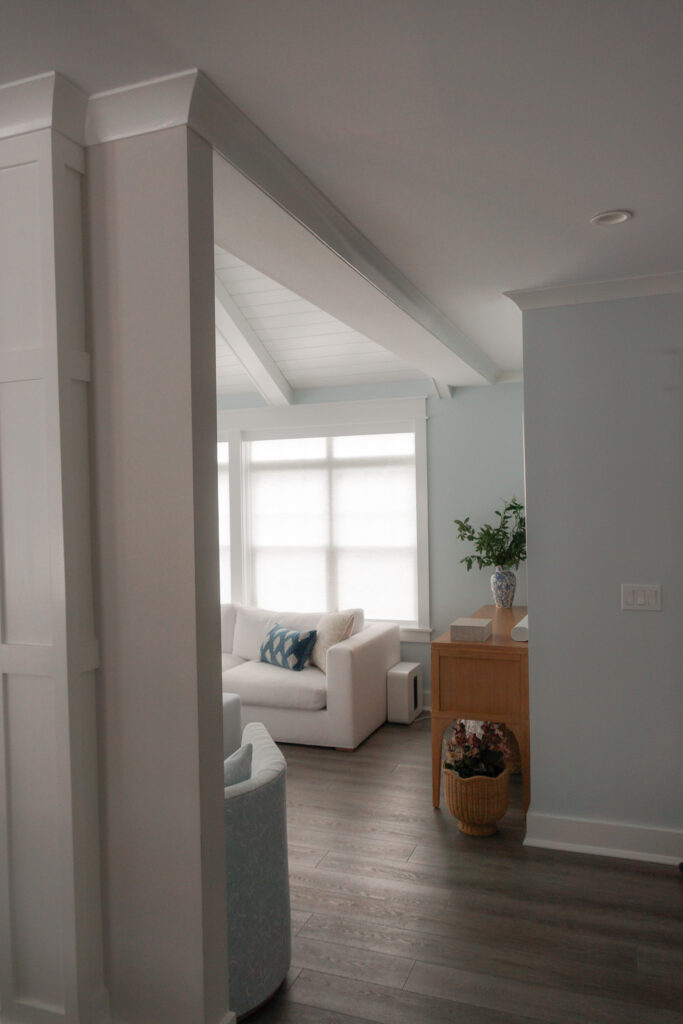
The room itself also presented spatial complexity. With multiple entrances and exits creating constant visual interruption, and several competing focal points pulling attention in different directions, establishing a clear visual hierarchy was essential before any furniture or décor decisions could be made. A room with no clear anchor feels restless, regardless of how beautiful the individual pieces are. The windows — and the ocean beyond them — were the obvious choice. Every other decision would have to either support that focal point or quietly step aside.
The Seawillow Studio Approach: Editing, Not Overhauling
We didn’t come in swinging. This room didn’t need a renovation; it needed editing. Our job was to identify the highest-impact changes, execute them with precision, and resist the temptation to do more than the room required.
This is, in many ways, the harder discipline. It’s easier to strip a room and rebuild it than to look carefully at what exists and understand which elements are working, which are holding the space back, and which simply need to be replaced with something better. Restraint in interior design is a skill — and it’s one that saves clients significant money without sacrificing the quality of the outcome.
The windows came first. We replaced the heavy, light-blocking roman shades with custom motorized roller blinds from Hunter Douglas, and went a step further by building the cassette directly into the window at the top of the casing. The result is seamless — when raised, the blinds disappear entirely, leaving nothing between the room and that ocean view. It was an immediate and striking transformation, and it set the tone for everything that followed. The room suddenly had a reason to exist: to frame that view, to live in that light.
The paint came next. We refreshed the walls in Borrowed Light by Farrow & Ball — a similar blue-gray to what had been there before, but unmistakably more refined. Borrowed Light has a luminosity that flat latex simply can’t replicate; it shifts through the day, reading almost white in direct sun and deepening to a quiet, contemplative soft blue in the evening. It’s the kind of paint color that makes people say a room feels expensive without being able to explain why. The upgrade was nearly immediate.
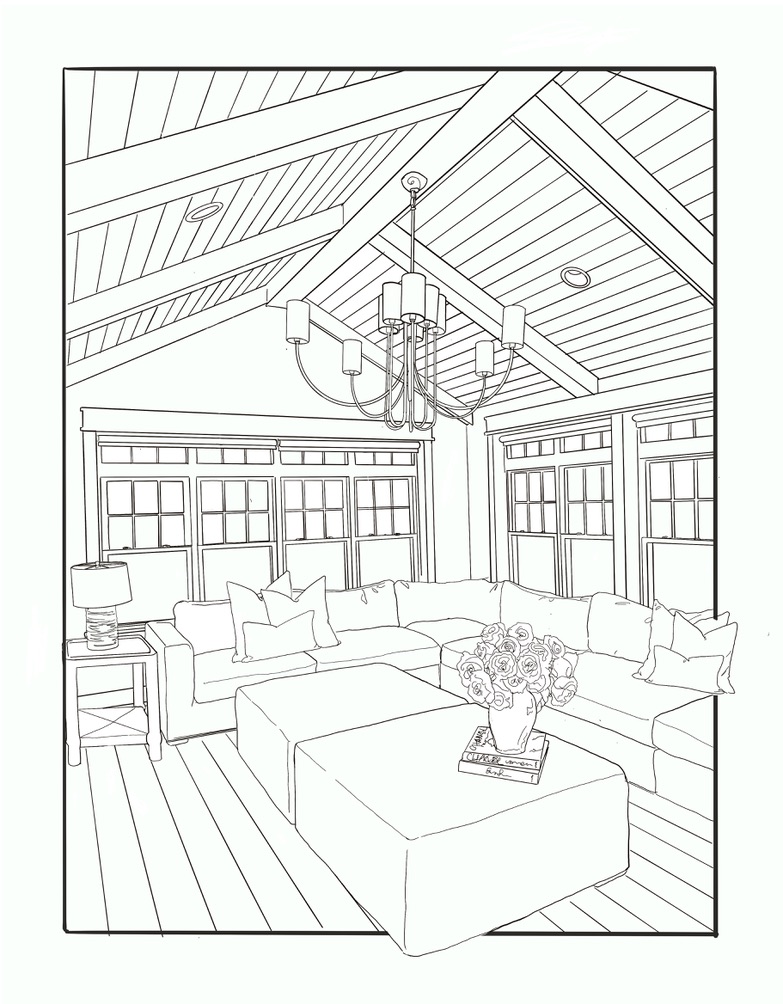
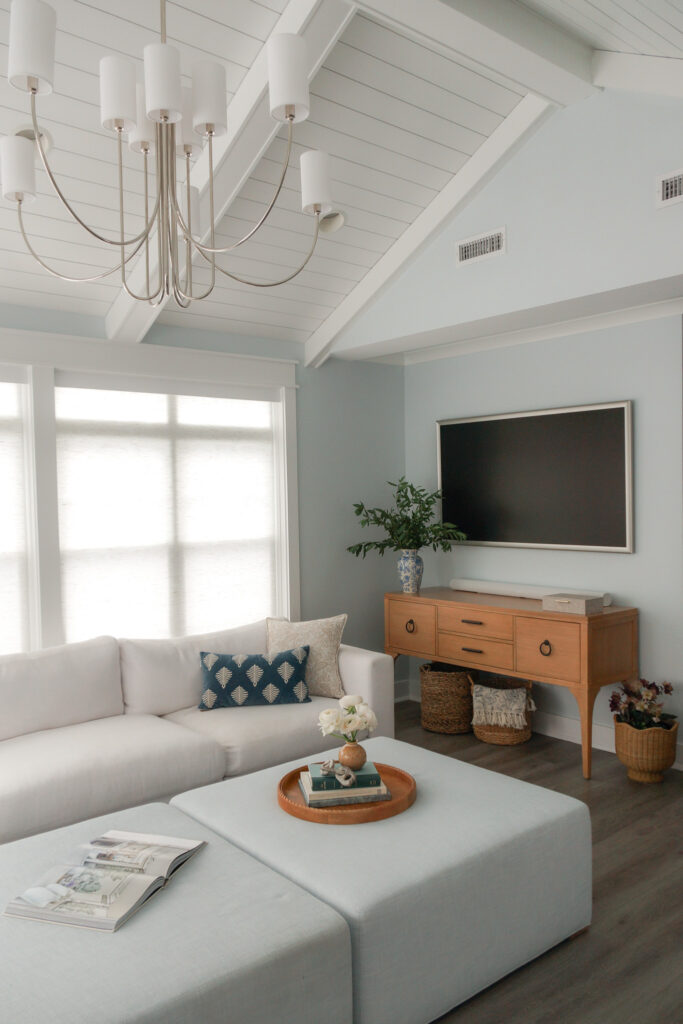
The ceiling fan was replaced with a chandelier. This single swap may be the single most impactful decision of the entire project — and it’s one of our favorite examples of how targeted investment in the right element can transform a room entirely. The Harlem Chandelier brought genuine glamour to a space that had been held back by a perfectly adequate but entirely uninspiring fan. There are certainly moments in coastal Connecticut homes where a ceiling fan earns its place — and there are beautiful, well-designed fans that can do real work in a room. This was not one of those moments.
The chandelier’s silver detailing speaks directly to her cool-toned palette. Its small individual lampshades preserve a classicism that keeps the space from feeling trendy or trying too hard. It is chic and modern and quietly timeless all at once — and it anchors the shiplap ceiling in a way that nothing else could have. It’s larger scale also makes the room feel grand and brings the eye up into the vaulted ceiling. Truthfully, we could have stopped at the paint and the chandelier and walked away with a significant transformation. Everything that came after was refinement.
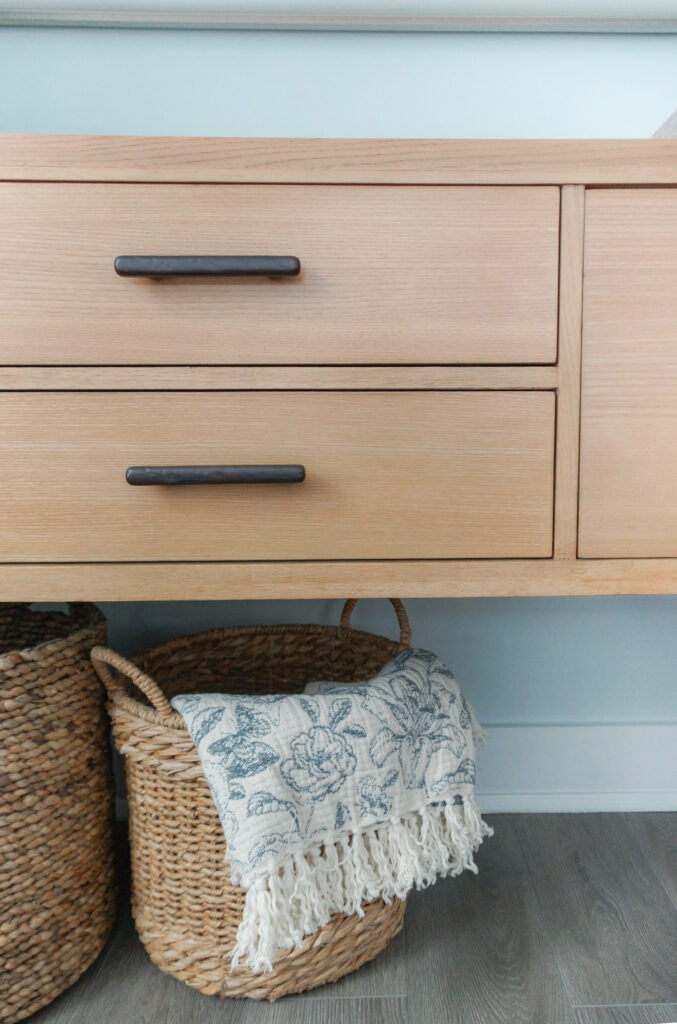
A console table grounded the television corner. Rather than leaving the TV floating on the wall in the way of so many living rooms, we introduced the Lexington Seaside Sideboard beneath a Picture Frame TV — a design that functions as both furniture and art. When the screen is off, it reads as a framed painting on the wall. When it’s on, it integrates seamlessly into the room rather than dominating it. The console’s natural wood tone served an additional purpose: it visually connected to the client’s dining room table, one of the few pieces she carried from her previous home, which is visible within the sightlines of the den. That continuity — honoring the pieces that carry meaning — is something we pay close attention to in every Connecticut home we design.
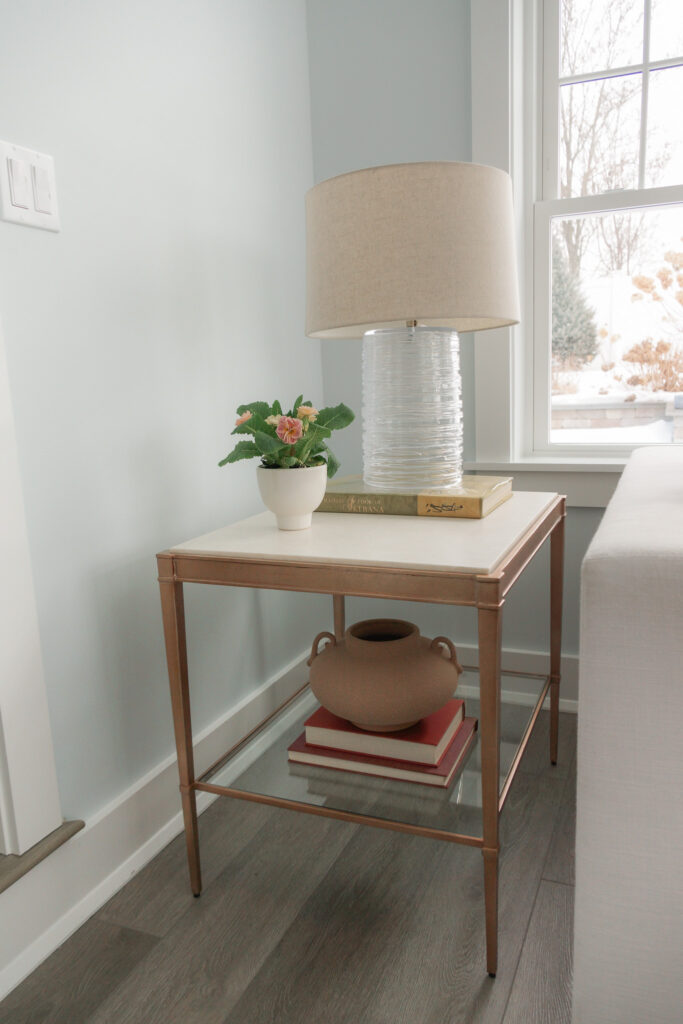
The side table required two attempts. We brought in an initial version that arrived far too dark, dragging the room’s energy down rather than lifting it. We pivoted entirely, moving away from wood and selecting a rose gold metal base with a marble top. It was exactly the right call. Because the room receives such extraordinary light throughout the day, the metal shifts its warmth with the moving sun — cooler in the morning, warmer in the afternoon — pulling the natural environment into the space in a way that feels effortless rather than engineered. It adds a feminine touch that was present in her original furniture selection and needed to be echoed somewhere in the room’s hard pieces.
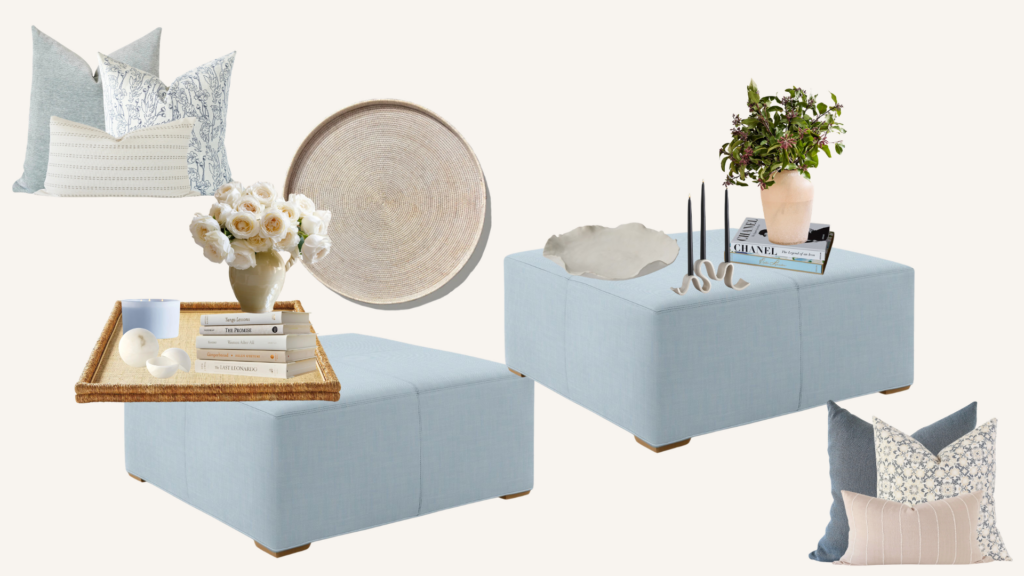
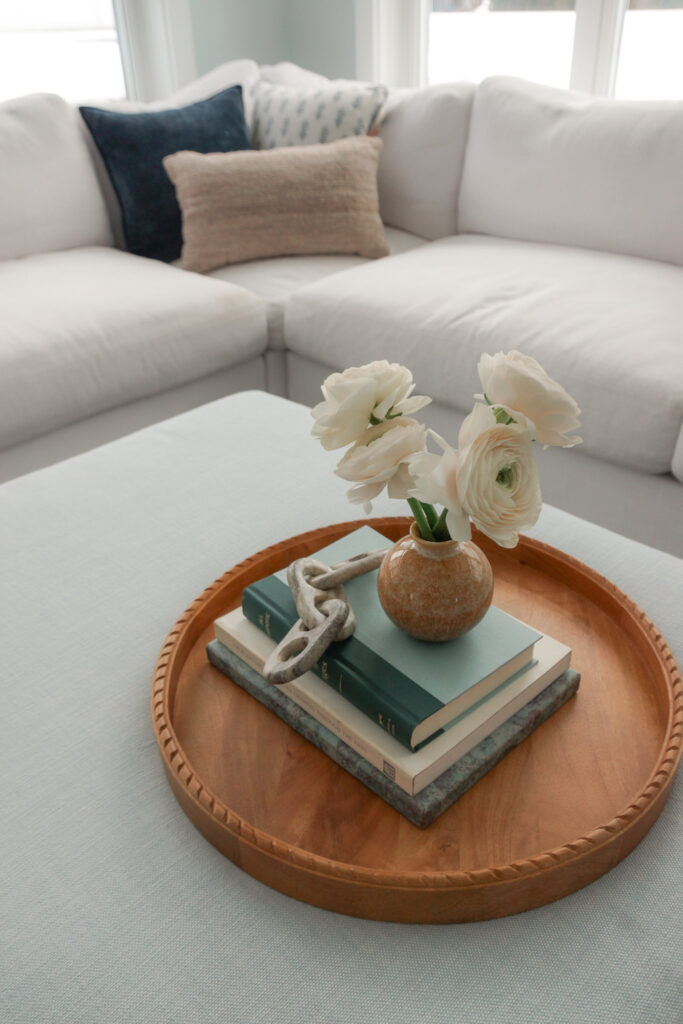
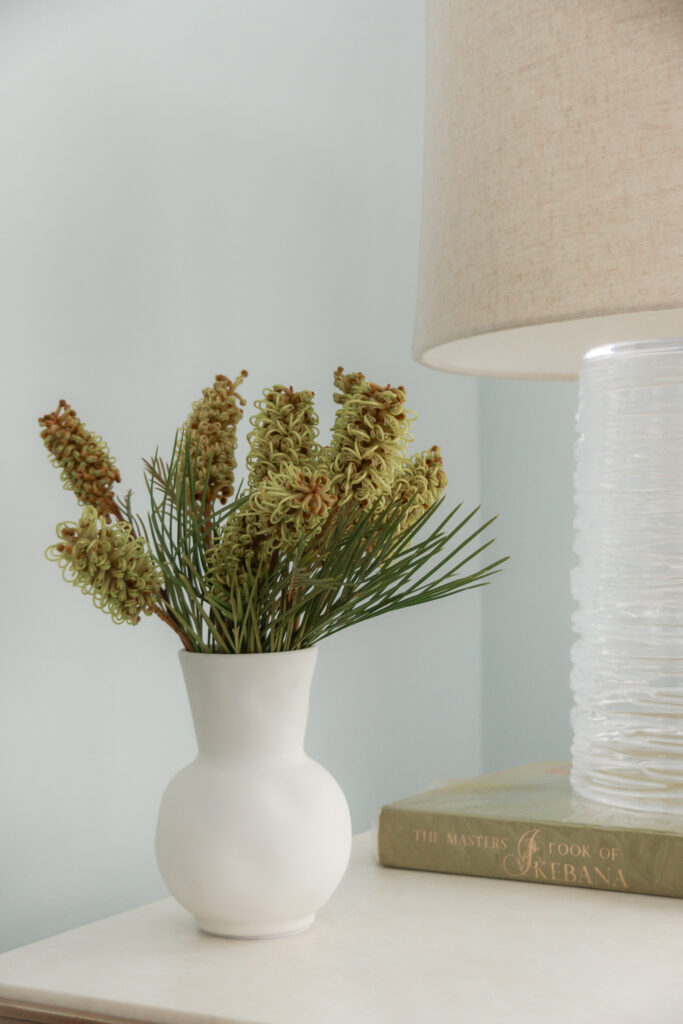
The finishing layer came last. A treasured lamp purchased during the couple’s many travels — the Echo Lake Wide from Simon Pearce — brought both function and sculptural presence. Fresh pillows from HomeGoods introduced softness without requiring custom upholstery. A curated collection of trays, ceramics, and small white vases gave the console and end table their final, styled polish. None of it was precious. All of it was intentional.
The Result: A Room That Feels Like Its Owner
When you walk into this den now, it simply feels like a pretty room. Not a designed room. Not a renovated room. Not a room that announces the hand of an interior designer. A room that feels exactly like the person who lives in it — which is, in our view, the highest possible compliment in residential design.
Guests stop in the doorway. They comment. They can’t quite say what changed or why it feels so different from how it looked before. The client feels at home in a way she hadn’t since moving in. The ocean is visible through clean, unobstructed glass. The chandelier catches the afternoon light. The room breathes.
That’s the goal, every time. Not a room you notice. A room you sink into.
What This Project Taught Us
Every project leaves us with something. This one reinforced a principle we return to often in our Connecticut interior design work: the most powerful transformations aren’t always the most expensive ones. They’re the most considered ones.
Paint and lighting alone — two of the least invasive interventions available to a designer — completely reframed this space. Everything else was additive. For clients who are hesitant about the scope or cost of working with an interior designer, this project is one we point to often. The investment was targeted, the results were dramatic, and the room now functions exactly the way its owner always imagined it could.
It also reminded us of something important about coastal interior design in Connecticut specifically: the landscape outside a window is one of the most powerful design elements available to you. When you have an ocean view, a salt marsh, a river, or even just a particularly beautiful tree line, your job as a designer is to get out of the way and let it in. Every decision we made in this room — the motorized blinds, the cool palette, the restrained layering — was in service of that view. The room doesn’t compete with what’s outside. It frames it.
If you’re sitting in a home that feels close but not quite right — a recently renovated space that doesn’t quite feel like you, or a room that’s functional but never quite beautiful — that’s exactly the kind of project Seawillow Studio was built for. A refresh doesn’t have to mean a reinvention. Sometimes it just means knowing which three things to change, and having the confidence to leave everything else alone.
Shop the Look
Recreate elements of this Connecticut coastal interior with our curated source list:
- Sofa & Ottoman — Norfolk Ottoman, Serena & Lily
- Chandelier — Harlem Chandelier in Old Bronze, HVL Group
- Console / Sideboard — Seaside Sideboard, Lexington Furniture
- Side Table — Bulgari Rectangle End Table, France & Son
- Lamp — Echo Lake Lamp Wide, Simon Pearce
- Paint — Borrowed Light, Farrow & Ball
- TV Frame — Picture Frame TV, DecoTV Frames
- Wood Tray — Threshold x Studio McGee Wood Tray, Target
- White Ceramic Vase — White Ceramic Vase 12″, At Home
- Small White Vase — Tracey Boyd White Ceramic Vase, At Home
- Round Scalloped Tray — Room Essentials Ceramic Tray, Target
- Marble Figurine Tray Detail — Beige Marble Link Figurine, At Home


A Note from the Designer
The chandelier is what I’m most proud of in this project. Swapping out that ceiling fan changed the entire feeling of the room — instantly. It’s not overwhelming; it’s just right. The silver lines, the delicate fuss-free lampshades, the way it holds its own without competing with anything else in the space — that’s the kind of choice that does all the quiet work of elevating a room without announcing itself.
We could have stopped at the paint and the chandelier and it still would have been a major upgrade. But the layering — the console table that grounds the TV corner, the side table that shifts warmth with the afternoon sun, the blinds that finally let the ocean in — that’s what makes it feel whole. That’s what makes it feel like her.
— Emma, Seawillow Studio
Seawillow Studio is a Connecticut-based interior design firm specializing in elevated, livable spaces that feel personal, artful, and effortlessly refined. Whether you’re starting from scratch or refreshing a space that’s close but not quite right, we’d love to hear about your project. Get in touch.

